Português


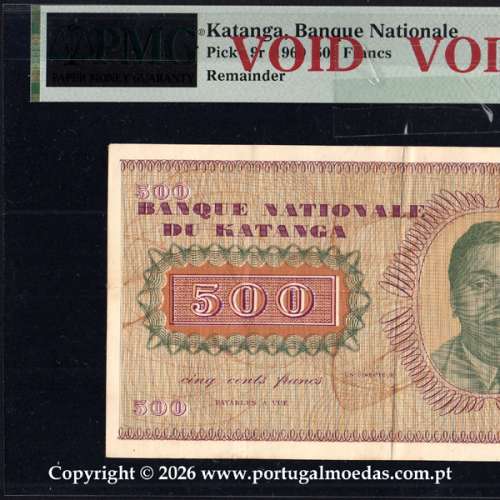
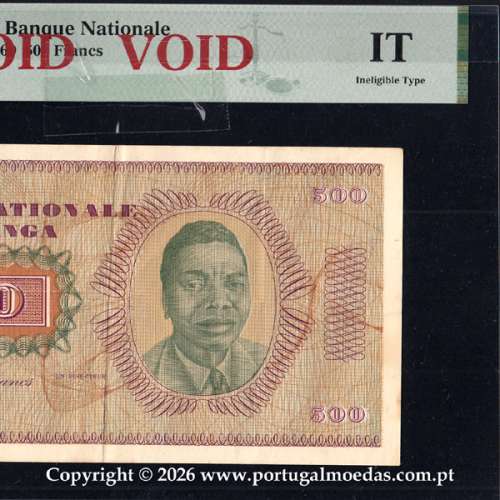
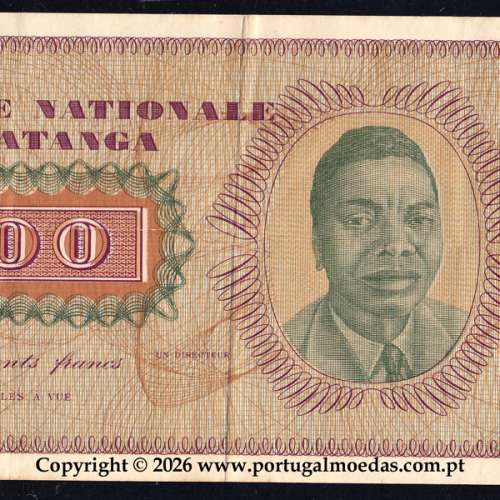
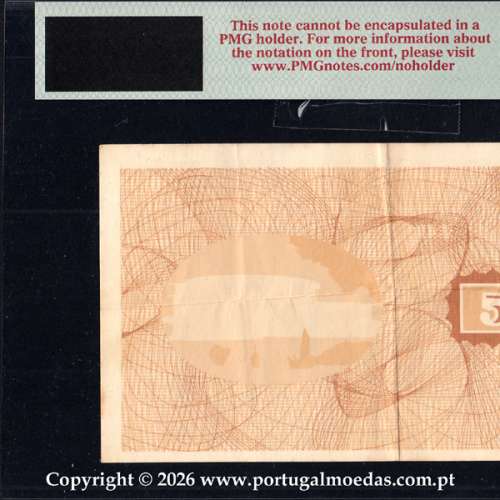
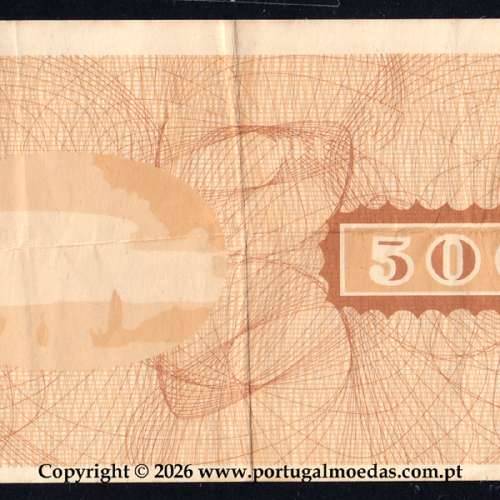
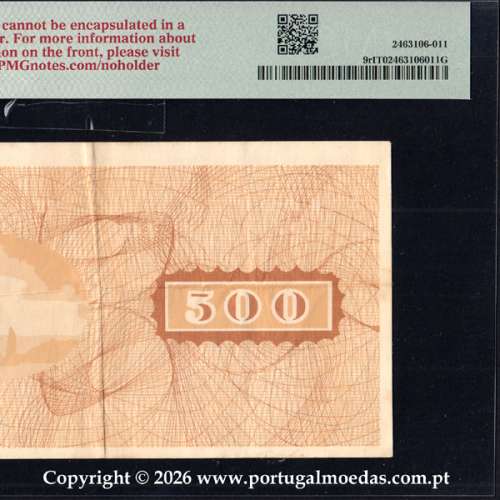
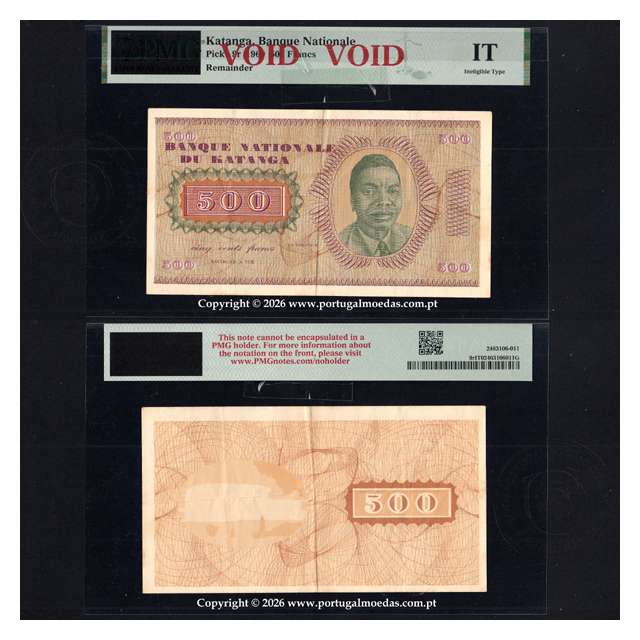
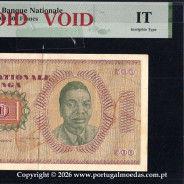
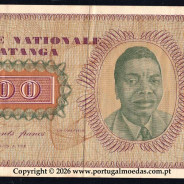
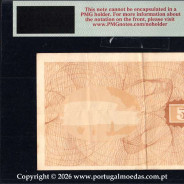
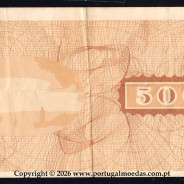
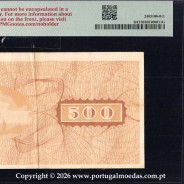
Katanga, 500 Francs 1960 — Incomplete Printing Proof (Pick 9 — Intermediate Production Stage)— PMG Ineligible Type (Remainder)
(A foto que está a visualizar, corresponde á nota que vai receber na sua encomenda)
Descriptive Characteristics:
Origin, Authenticity and Technical Framework of the Katanga Printing Proofs (1960)
When presenting this note — part of a group of printing proofs and experimental pieces whose origin is explained below — it is important to clarify its technical context and the certification process it underwent.
All items from this lot were submitted for evaluation by Paper Money Guaranty (PMG), the leading international authority in banknote certification. The results revealed an essential distinction:
Notes corresponding to catalogued types — namely those listed in the Standard Catalog of World Paper Money — were encapsulated and graded normally.
Printing proofs and experimental pieces, however, were classified as “Ineligible Type”, as they do not fall within the category of notes issued for circulation.
These items were not rejected as counterfeit — something PMG always states explicitly when it occurs — but were instead identified as material not eligible for encapsulation, as they do not have an assigned Pick reference. Even so, they were returned in individual PMG sleeves, labeled with the designation “Ineligible Type” / “Remainder”, ensuring their preservation, traceability, and proper technical classification within the certification process.
The banknotes issued by Katanga between 1960 and 1961 are today among the most fascinating and scarce testimonies of African paper‑money history. Following the province’s declaration of independence in July 1960, Katanga sought to assert its political and economic sovereignty. For roughly two and a half years — until reintegration into the Republic of the Congo in 1963 — the state developed its own administrative structure, including the creation of currency and banknotes that are now rarely seen on the collectors’ market.
Regular notes were introduced on 9 January 1961, in denominations of 10, 20, 50, 100, 500 and 1000 francs. This first series, featuring the portrait of Moïse Tshombe, was printed by the Swiss company Roto‑Sadag SA in Geneva, and subsequently finished at a specialized facility in Solothurn. This detail is crucial to understanding not only the technical quality of the notes, but also the existence of preparatory printing material associated with their production.
In a context of political instability and administrative urgency, the production of these notes involved several experimental phases: graphic trials, color proofs, printing tests, plate alignment checks, and technical adjustments. It is precisely from this process that some of the rarest and previously undocumented pieces in Katanga’s monetary history emerged — the printing proofs.
The pieces presented here belong to this extremely restricted universe. Not intended for circulation, they represent intermediate stages of the creation process, used to validate colors, test plates, adjust security elements, and approve the final design. By nature, they were produced in very small quantities and, in most cases, destroyed once testing was completed. Only a handful of examples survived — and almost always of the final notes, not of the intermediate stages.
Among these proofs are particularly unusual variants, such as overprinted impressions, color tests on reused sheets, or elements of different denominations printed on the same substrate — clear evidence of the experimental and functional nature of these materials during production.
The origin of this group adds an additional layer of uniqueness. The pieces come from the collection of a late Luso‑descendant collector who lived and worked for many years in Switzerland — precisely the country where these notes were produced. Among his archives were these Katanga rarities, preserved for decades and now revealed to the public for the first time.
It is important to emphasize that printing proofs from this specific issue are virtually unknown on the market, rarely appearing in commercial circuits, international auctions, or publicly accessible institutional collections. Their presence outside specialized archives is exceptional, giving them not only historical value but also significant interest for advanced collectors.
These pieces should not be viewed as mere curiosities or simple variants, but as authentic fragments of the monetary creation process of a short‑lived state. They represent the moment when the idea of a currency becomes a physical object — even before entering circulation. In this sense, they stand as direct witnesses to the ambition, urgency, and technical complexity that shaped Katanga’s brief independent history.
All images published on our website include a watermark with the platform’s address, in order to protect copyright and prevent unauthorized reproduction. Any full or partial use of these images without express permission is strictly prohibited.
Copyright © 2026 www.portugalmoedas.com.pt (All rights reserved)
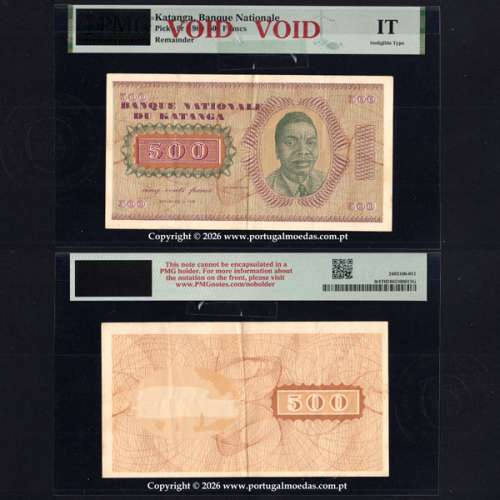
Intermediate printing proof of the 500 Francs 1960 Katanga note (Pick 9r), produced by Roto‑Sadag during the alignment and color‑registration phase. The obverse shows three printing layers without the final black layer (signatures, date, serial numbers), while the reverse displays only the first brown layer. An exceptionally rare production artifact.
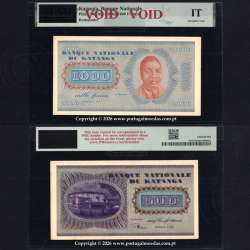
Printing Proof and Color Proof of the 1000 Francs 1960 banknote (Pick 10r), PMG Ineligible Type - Remainder (Printing Proof). It received the three normal printing layers on the obverse and reverse, but without the final black layer. The singular characteristic of this piece is the complete surcharge of the reverse of the 500 Francs note (Pick 9r) applied over the reverse of Pick 10, revealing a technical workshop error and an extremely rare reuse of plates.
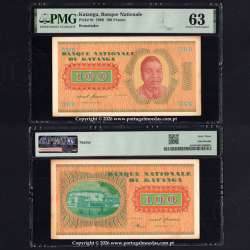
100 Francs banknote from Katanga, 1960 issue, certified PMG 63 Choice Uncirculated. This is the Pick 8r type, a genuine remainder printed by Roto‑Sadag in Switzerland, without serial number, date or signature. A very rare example from Katanga’s first monetary issue, with excellent eye appeal and strong historical and collector interest.
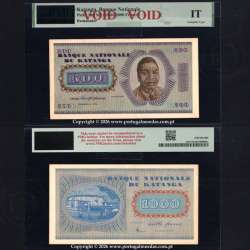
Printing proof and colour proof of the Katanga 500 Francs 1960 banknote (Pick 9r), PMG Ineligible Type – Remainder (Printing Proof). This variant shows three complete printing layers on the reverse, while the obverse displays only the first brown tonal layer, revealing an early stage of the production process. It is a technical piece of exceptional rarity.
Printing Proof – Color Proof of the 1000 Francs 1960 banknote (Pick 10r), PMG Ineligible Type (Printing Proof). It received the three normal printing layers on the obverse and reverse, but without the final black layer. The singular characteristic of this piece is the complete overprint of the obverse of the 500 Francs note (Pick 9r) applied over the obverse of Pick 10r, revealing a technical workshop error and an extremely rare reuse of plates.
Intermediate printing proof of the 500 Francs 1960 Katanga note (Pick 9r), produced by Roto‑Sadag during the alignment and color‑registration phase. The obverse shows three printing layers without the final black layer (signatures, date, serial numbers), while the reverse displays only the first brown layer. An exceptionally rare production artifact.