Do you want to sell?

Contact us to know how

We buy collections or single pieces of coins, banknotes, stamps, military awards, medals, old postcards, old letters, manuscripts, antiquities and other collectible items.

Send us your list of missing items

Monarchy Coins | Republic | Foreign | Former Portuguese Colonies | Stamps

Coins of King Afonso V (1438-1481)

The coins of King Afonso V, known as “the African”, reflect a reign marked by military campaigns in North Africa, the strengthening of royal authority and the consolidation of the Avis Dynasty. He ruled from 1438 to 1481, promoting territorial expansion and supporting economic development during a period of increasing maritime activity. His coinage is diverse, including copper ceitils, black half reals, white reals, cotrins, espadins, leais, chinfrões and real grosso issues, illustrating the technical and artistic evolution of Portuguese numismatics in the 15th century. These coins are highly valued by collectors for their variety, symbolism and historical significance.

Coins of King Afonso V  (1438-1481)

There are 223 products.

Showing 1-48 of 223 item(s)

Active filters

Ref: MQ.2D.AG.A5.15.04

Portugal, cotrim coin of King Afonso V (1438–1481), without mint mark, atypical variant, corresponding to a specimen published.

€650.00

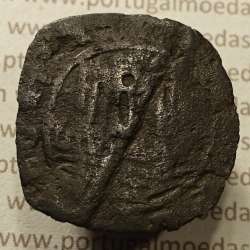
This is a portuguese billon coin of cotrim of King Afonso V (1438–1481), without mint mark, which I consider to represent a variant with previously unrecorded features. Several elements appear atypical when compared with specimens known to me that have appeared on the market in recent years. On the obverse, within an arc of a circle, is the crowned royal monogram, with a narrower crown decorated with pellets, and no mint mark is present. In the monogram, the uncial letter “A” displays a distinctive ornamental feature, with the terminal of the left stroke overlapping the main body of the letter. The circular arc does not touch the crowned monogram at any point. The legend is indistinct and illegible; however, the sequence “.QVI. F....” can be discerned in the lower part.

On the reverse, four triple lobed arches are linked by pellets, with additional inner pellets connecting the arches. At the outer corners of the lobed arches, dots appear instead of pellets, which constitutes a noteworthy peculiarity. The beginning of the legend, normally marked by a simple St. George–type cross, appears in this specimen to be a floriated cross. The legend is likewise indistinct and illegible; nevertheless, at the upper part it is possible to distinguish the beginning and the end of the inscription, seemingly reading “....I F A + AL....”. This reading cannot be confirmed with certainty, and it also seems unusual for this coin type to have legends ending with the letter “A”.

This specimen corresponds to the coin illustrated and published in fascicle 13, page 11, of the collection History of Portugal in Coins (Copyright © Cofina and Atlântico Press), with a partial image of the relevant page attached.
Ref: MQ.2D.AG.A5.20.23.A

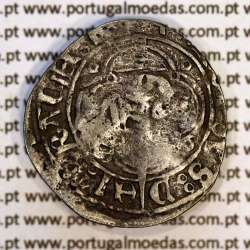
Espadim coin of King Afonso V (1438–1481), a rare variant with the obverse legend separated by double annulets "8"

€600.00

Espadim coin of King Afonso V (1438–1481), Espadim or 4 Reais Brancos, a rare variant with the obverse legend separated by double annulets instead of the usual two dots. Legend: +ALFONSVS 8 DEI 8 GRACIE 8 R / + ADIVTORIVN : NOSTRVN : IN : N. The Espadim has always been a highly prized coin among collectors, not only because of its scarcity but also due to its central allegory, which is extremely original considering the period in which it was struck, presenting a design that clearly stands out from other coins of its time. Within a smooth circular border, the field displays four double tetralobed arches, adorned on both the inner and outer sides with annulets, over which is superimposed a hand emerging from the right, grasping a short sword by the upper part of the blade. The sword runs along the entire central axis of the coin, with the legend interrupted at the hilt and at the tip of the blade; to the left, directly in front of the hand, appears the letter “A”. The Espadins were struck during the reign of King Afonso V, known as “The African,” the twelfth King of Portugal, born in 1432 and who reigned from 1438 until his death in 1481. His consort was Queen Isabel of Lancaster.