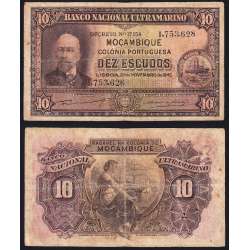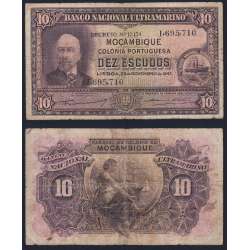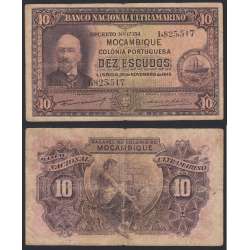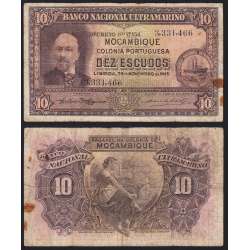
Do you want to sell?

Contact us to know how

We buy collections or single pieces of coins, banknotes, stamps, military awards, medals, old postcards, old letters, manuscripts, antiquities and other collectible items.

Send us your list of missing items

Monarchy Coins | Republic | Foreign | Former Portuguese Colonies | Stamps

Mozambique – Former Colony Banknotes

The banknotes of the former colony of Mozambique form one of the most diverse and historically significant sets of Portuguese ultramarine paper‑money, comprising fiduciary issues produced from the 19th century to 1975 by both the Banco Nacional Ultramarino and the Mozambique Company, which held issuing privileges in part of the territory. These issues include banknotes, certificates, specimens, cédulas and special series that illustrate monetary reforms, evolving denominations, territorial iconography and the financial structure of both the colonial administration and the autonomous company. Their diversity, artistic richness and historical relevance make them highly valued by collectors and researchers studying Portuguese overseas monetary history. Banknotes issued after Mozambique’s independence are not part of this category and are listed under Foreign Banknotes → Africa → Mozambique.

Mozambique Former Colony Banknotes – Ultramarine Paper‑Money, BNU & Mozambique Company Issues, Rare Series

There are 62 products.

Showing 1-48 of 62 item(s)

Active filters

Ref: NT.MC.056. A1

Mozambique, 10 Centavos 1914 (November 5, 1914), Banco Nacional Ultramarino, Lourenço Marques, (Circulated), Mozambique Pick56

€50.00

Mozambique 10 Centavos 1914 banknote issued by the Banco Nacional Ultramarino for circulation in Lourenço Marques. Printed by Bradbury, Wilkinson & Co. Ltd., it features the BNU green seal, the Portuguese coat of arms, and signatures of Governor Luiz Diogo da Silva and Vice‑Governor Manuel Carlos de Freitas Alzina. The reverse shows a classical maritime allegory. Listed as Pick 56, this note belongs to the early “London” emergency issue of 1914.
Ref: NT.MC.056.A3

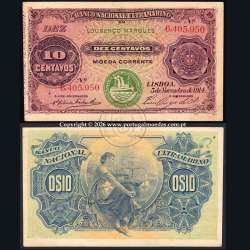
Mozambique, 10 Centavos 1914, Banco Nacional Ultramarino, Lourenço Marques, (Circulated), Mozambique Pick56

€55.00

10 Centavos banknote issued on November 5, 1914 by the Banco Nacional Ultramarino for circulation in Lourenço Marques (present-day Maputo, Mozambique), bearing the serial number 6,405,950. Printed by Bradbury, Wilkinson & Co. Ltd., the obverse features the denomination prominently displayed, the green BNU seal, and the Portuguese coat of arms, along with the signatures of Governor Luiz Diogo da Silva and Vice-Governor Manuel Carlos de Freitas Alzina. The reverse displays an allegorical figure representing navigation, a characteristic motif of early 20th-century colonial issues. Cataloged as Pick#56, this banknote belongs to the first “London” issue, produced in a context of monetary emergency.

Ref: NT.MC.057. B2

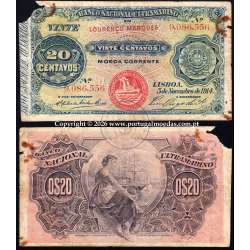
Mozambique, 20 Centavos 1914, Banco Nacional Ultramarino, Lourenço Marques , (Circulated), Mozambique Pick57

€38.00

20 Centavos banknote issued in 1914 by Banco Nacional Ultramarino for circulation in Lourenço Marques, printed by Bradbury, Wilkinson & Co. Ltd. Part of the “London” series, featuring red serial numbers, the institutional seal, and signatures of Governor Luiz Diogo da Silva and Vice‑Governor Manuel Carlos de Freitas Alzina. Reference Pick#57.

Ref: NT.MC.058.B6

Mozambique, 50 Centavos 1914 (5 November 1914), Banco Nacional Ultramarino, Lourenço Marques, (Circulated), Pick58

€45.00

50 Centavos banknote issued in 1914 by Banco Nacional Ultramarino for circulation in Lourenço Marques, printed by Bradbury, Wilkinson & Co. Ltd. Part of the “London” series, featuring red serial numbers, the institutional seal, and signatures of Governor Luiz Diogo da Silva and Vice‑Governor Manuel Carlos de Freitas Alzina. Reference Pick#58.

Ref: NT.MC.069.B

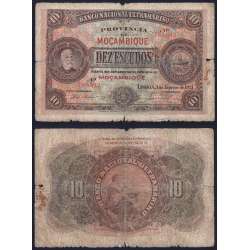
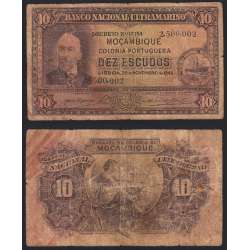
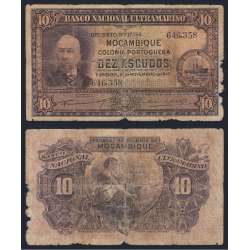
Mozambique, 10 Escudos 1921 (January 1, 1921), Francisco de Oliveira Chamiço, Banco Nacional Ultramarino, (Circulated), Pick69

€100.00

Mozambique 10 Escudos 1921, issued by the Banco Nacional Ultramarino and printed by Bradbury Wilkinson & Co. The obverse features the portrait of Francisco de Oliveira Chamiço, the Portuguese coat of arms and the maritime seal associated with the BNU, with signatures of HJMM and JHU. The reverse presents a classical allegorical composition typical of early 20th‑century colonial issues. Listed as Pick 69, this note is sought after by collectors of Mozambique and Portuguese colonial paper money.

Ref: NT.MC.079.A1

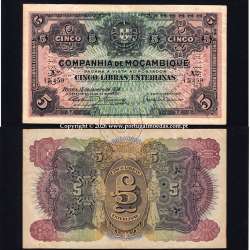
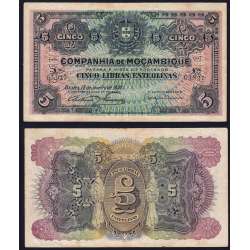
Mozambique, 5 Pounds Sterling 1934 (15 January 1934), Mozambique Company – Beira, World Paper Money PickR32, SN.13,459

€27.00

The 5 Pounds Sterling 1934 banknote of the Mozambique Company belongs to the final sterling issue produced for circulation within the Company’s concession territory. Printed by Bradbury, Wilkinson & Co., it features the refined colonial design typical of high‑value notes: central allegorical vignette, Company coat of arms, ornate borders and elegant typography.

The perforation “PAGO 5.11.1942” was used for internal administrative settlements and does not affect authenticity. The signatures correspond to the official authorities of the period: António Augusto Pereira Cabral (Governor) and António de Sousa Lara (Managing Administrator).

This note represents an important historical period, marking the final phase of the Company’s financial autonomy before full integration into the Portuguese monetary system.

Ref: NT.MC.082.A1

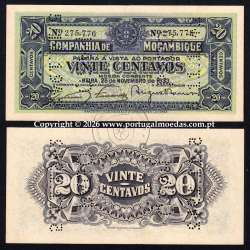
Mozambique, 20 Centavos 1933 — Mozambique Company — Beira — Serial 275,776, (UNC), World Paper Money Pick R29

€12.50

The 20 Centavos 1933 banknote, issued by the Mozambique Company in Beira, belongs to the final phase of sterling‑denominated fractional issues before the Company’s powers were abolished in 1942. Printed by BRADBURY, WILKINSON & CO. LTD. LONDON, it features a clean, functional design with the Portuguese Coat of Arms, geometric borders and a prominent face value. This example bears serial number 275,776, is preserved in UNC condition, and includes the “PAGO 5.11.1942” perforation applied during the liquidation of these issues. A historically significant piece representing low‑value fiduciary currency in colonial Mozambique.