Contact us to know how
We buy collections or single pieces of coins, banknotes, stamps, military awards, medals, old postcards, old letters, manuscripts, antiquities and other collectible items.
Monarchy Coins | Republic | Foreign | Former Portuguese Colonies | Stamps
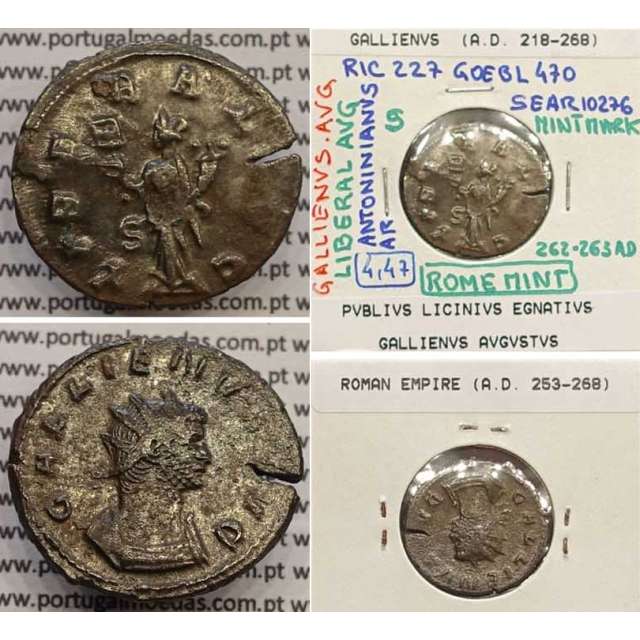
ANTONINIANO EM BOLHÃO ANO 262 A 263 d.C
Legenda do verso: GALLIENVS AVG
Legenda do reverso: LIBERAL AVG
Gallienvs - Antoninianus LIBERAL AVG / GALLIENVS AVG
Antoninianus 21mm (4,47 gramas) cunhagem atribuída a cerca de 262 - 263 d.C., de Roma tambem atual cidade no presente em Itália.
Referências Internacionais Primárias de Vários Catálogos: RIC 227; Goebl 0470, Sear 10276, RSC, Cohen 562.563 (Veja por favor, como existem várias variantes)
GALLIENVS AVG, irradie a cabeça para a direita
LIBERAL AVG, Liberalitas em pé à esquerda, segurando tessela e cornucópia, S no campo direito
LIBERAL AVG - LIBERALITAS - A liberalidade, sendo uma das virtudes principescas e ao mesmo tempo uma das mais populares, aparece tanto como lenda quanto como um tipo de grande número de medalhas imperiais romanas. Estas atestam as ocasiões em que os imperadores faziam uma demonstração da sua generosidade para com o povo, por todos os tipos de distribuições entre eles, em dinheiro e provisões. Na idade mais adiantada isso foi chamado Congiarium (Munus), porque eles distribuíram congos oleo plenos. No tempo da república livre, os Ediles foram especialmente encarregados dessas distribuições, como um meio de adquirir a boa vontade do povo. A mesma prática foi seguida pelos imperadores.
Breve história do Imperador:
GALIENOPVBLIVS LICINIVS EGNATIVS GALLIENVS
Imperador do ano 253 d.C. a ano 268 d.C.
Nasceu no ano 218 d.C. morreu no ano 268 d.C.
Reinou durante 15 anos.Casou com Salonina.Pai de Valeriano II, Salonino e Júlio Galieno.
--------------------------x------------------
Gallienvs - Antoninianus LIBERAL AVG / GALLIENVS AVG
Antoninianus 21mm (4.47 grams) coinage attributed to circa 262 - 263 A.D, of Rome the presente city in Italy.
Primary International References of Various Catalogs: RIC 227; Goebl 0470, Sear 10276, RSC , Cohen 562,563 (See please as there are several variants)
GALLIENVS AVG, Radiate head right
LIBERAL AVG, Liberalitas standing left, holding tessera and cornucopiae, S in right field
LIBERAL AVG - LIBERALITAS - Liberality, being one of the princely virtues and at the same time a most popular quality, appears both as a legend and as a type on a great many Roman imperial medals. These attest the occasions when the emperors made a display of their generosity towards the people by all kinds of distributions amongst them, in money and provisions. In the earlier age this was called Congiarium (Munus), because they distributed congios oleo plenos. In the time of the free republic, the Ediles were specially entrusted with these distributions, as a means of acquiring the good will of the people. The same practice was followed under the emperors.
Gallienus - Roman Emperor : 253-268 A.D
Gallienus "Publius Licinius Egnatius Gallienus Augustus" Born 218AD Died September 268 (aged 50), also known as Gallien,[2] was Roman Emperor with his father Valerian from 22 October 253 to spring 260 and alone from spring 260 to September 268. He ruled during the Crisis of the Third Century that nearly caused the collapse of the empire. While he won a number of military victories, he was unable to prevent the secession of important provinces. His 15-year reign was the longest since the 19-year rule of Caracalla.
Born into a wealthy and traditional senatorial family, Gallienus was the son of Valerian and Mariniana. Valerian became Emperor on 22 October 253 and had the Roman senate elevate Gallienus to the ranks of Caesar and Augustus. Valerian divided the empire between him and his son, with Valerian ruling the east and his son the west. Gallienus defeated the usurper Ingenuus in 258 and destroyed an Alemanni army at Mediolanum in 259.
The defeat and capture of Valerian at Edessa in 260 by the Sasanian Empire threw the Roman Empire into the chaos of civil war. Control of the whole empire passed to Gallienus. He defeated the eastern usurpers Macrianus Major Mussius Aemilianus in 261–262 but failed to stop the formation of the breakaway Gallic Empire under general Postumus. Aureolus, another usurper, proclaimed himself emperor in Mediolanum in 268 but was defeated outside the city by Gallienus and besieged inside. While the siege was ongoing, Gallienus was stabbed to death by the officer Cecropius as part of a conspiracy.